
8 DECEMBER 2026 ACADEMIC & RESEARCH TRACK
Scientific Conference
In the 2026 Academic & Research Track of UnitedXR Europe, we aim to bring academia together with professionals from creative media and industry and offer XR professionals easier access to recent advances in applied research.
We invite members of the interactive and immersive technologies community who are active in research & development to contribute to this conference.
The call asks for presentations instead of scientific papers, which demonstrate recent advances in applied research and contributions to the discussion on ethical, legal, interoperability and inclusion aspects.
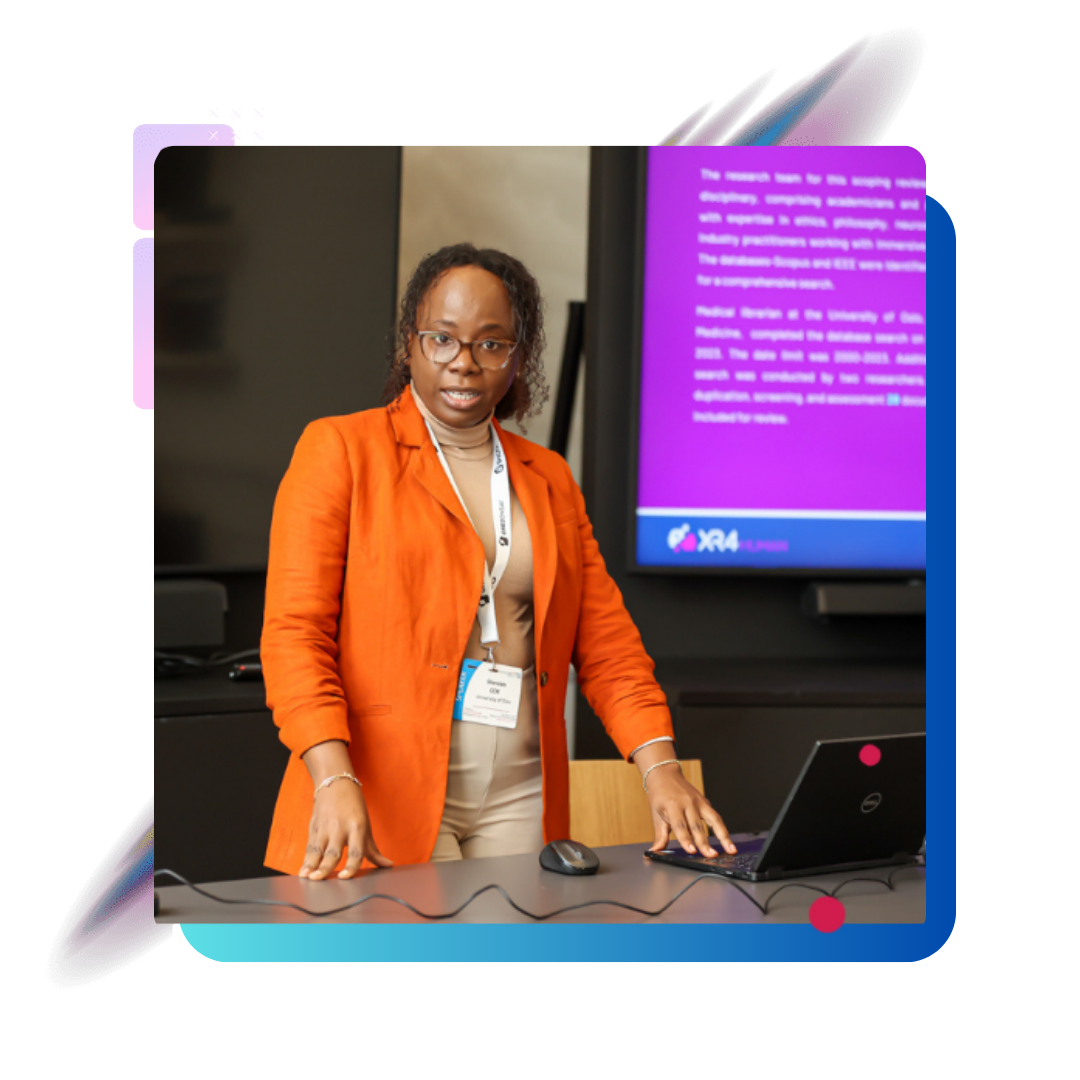
CALL FOR SCIENTIFIC PRESENTATIONS
sponsored by

Due to the success of the 2025 edition, we aim to increase the number of accepted submissions by offering an extended format. The conference is organised in two tracks:
- An oral track, on Tuesday, 8 December 2026, 9:00 - 13:00
- A poster track, in the main exhibition hall, close to the companies and startups of the XR industry. In addition to posters on display, there will be a Scientific Posters Showcase on Tuesday from 14:30 - 16:30 that will be listed on the agenda. That's when presenters are expected to be present to talk about their projects.
Applicants are invited to indicate their preference for either an oral presentation or a poster presentation. However, the organisers reserve the right to make the final decision regarding the format of each accepted contribution, based on the overall programme balance and content fit.
The best submission will be awarded both an oral presentation and a poster.
Through our sponsor, JMIR Publications, one selected paper will be published - reaching their global research community.
The submission should focus on the following topics:
- Capture and creation of audio-visual immersive content
- Novel 3D rendering techniques for ultra-realistic content (including holography) and/or real-time rendering
- Advances in interactive sensors and rendering devices for virtual reality (VR), augmented reality (AR), mixed reality (MR), and extended reality (XR).
- Advances in novel input sensor systems for XR (haptics, tracking, biometrics etc)
- Advances in spatial computing
- Advances in interoperability for interactive technologies
- User experience considerations in design of XR (Sensory/Perceptual/Emotion sciences)
- Social and psychological aspects of VR (Avatars, embodiment, sense-of-agency, collaboration, etc)
- Use of XR for interpreting human data and behavioural insights (e.g., through VR assessments, cognitive modelling, or psychometric evaluation)
NB: Product presentations are excluded.
Conditions and deadlines
We ask for a pdf-document, which contains the following information:
- Title of the presentation
- Author names and affiliation
- A 500-word abstract addressing the scientific aim or technical approach, the methods, results and conclusion
- Two illustrations or figures describing the approach and content of the talk
- A statement on the novelty of the submission
All the submitted proposals for presentations will be evaluated by an expert committee. The authors of accepted submissions will receive a complimentary 3-day pass for UnitedXR Europe 2026.
Timeline
Track Organisation
Dr. Oliver Schreer, Associate Professor TU Berlin, Head of Research Group at Fraunhofer Heinrich-Hertz-Institut, Germany
Dr. Jelle Demanet, Researcher and business developer emerging technologies at IMEC and Ghent University, Belgium
David Grogna, VR Expert, Cubic Space Technologies inc., Belgium
Scientific Committee
Dr. Carlo Campagnoli, Lecturer, School of Psychology of University of Leeds, United Kingdom, Head of Immersion, Cognition and Neuroscience (ICON) Research Group
Dr. Jelle Demanet, Researcher and business developer emerging technologies at IMEC and Ghent University, Belgium
Dr. Thierry Dutoit, Full Professor, Director of the NUMEDIART Institute for Creative Technologies, UMONS, Belgium
Dr. José Ferrer Costa, Innovation and Research Project Manager, Badalona Serveis Assistencials (BSA), Spain
Dr. Lene A. Hagen, Associate Professor of Optometry & Visual Science, University of South-Eastern Norway
Dr. Omar A. Niamut, Director of Science, TNO ICT, The Netherlands
Jan Pflüger, Consultant, advisXR, Germany
Dr. Artur Pilacinski, Researcher, Dept. of Neurotechnology, Ruhr University Bochum, Germany
Dr. Oliver Schreer, Associate Professor TU Berlin, Head of Research Group at Fraunhofer Heinrich-Hertz-Institut, Germany
Dr. Athanasia Symeonidou, Innovation Engineer - Medical XR, Materialise, Belgium
Georg Thallinger, Research Manager Smart Media Solutions, DIGITAL - The Institute for Information and Communication Technologies, JOANNEUM RESEARCH, Austria
Dr. Zerrin Yumak, Associate Professor at the Human-Centered Computing Group, Department of Information and Computing Sciences, Utrecht University, The Netherlands
Selected Papers
Explore the papers selected for the UnitedXR Europe 2026 Scientific Conference.
Reconstruction is not Recording
Richard Armstrong
Beyond paper and pencil: immersive spatial memory for the early detection of Alzheimer’s Disease
Van Vrekhem Tineke, Castegnaro Andrea, Sabbe Lode, Boon Paul, Scarioni Marta, Van Weehaeghe Donatienne, Balot Emile, Genbrugge Eva, Carrette Evelien, Van Langenhove Tim & Miatton Marijke
When and How to Use XR for Training: Practice-Derived Design Considerations from Multi-Domain Deployments
Leon Pietschmann, Fritz Pickhardt
Learning Through Immersive Digital Twins: Exploring Pedagogical Approaches in XR-Based Learning Environments
dr. Cristina Obae, Anny Nusrat
Ethical Dilemmas in the Design of VR-Enabled Training Environments
Eloïse Yang, Luka Rukonić, Suzanne Kieffer, Damien Renard
Designing XR for Autistic Children: Usability, Acceptability and Sensory Tolerability of an Immersive Nutrition Education Intervention
José Ferrer Costa, Anna Maria Vallmitjana Soler, Pol Florences Serra, Verónica Villarejo Romero, Tania González Penadés, Xavier Bayona-Huguet
Multiuser Immersive Cultural Experiences enabled by 5G, AI and Free-Viewpoint Video
Javier Usón, Isabel Rodriguez, César Díaz and Julián Cabrera
An EEG-Based Investigation of Cybersickness during Immersive VR Driving
Marc-Antoine Moinnereau, Abhishek Tiwari, Tiago H. Falk
Submovement Analysis of Virtual Reality Drawing for Assessing Upper-Limb Motor Performance
Merve Celik, Jason Friedman, Namit Mishra, Constantin Sinaschuk, Christian Klaes, Daghan Yuksel Piskin, Artur Pilacinski
Remembering Together: Co-Designing a Social VR Experience around historical memory supported by Generative AI
Patricia de Torres Coll, Sergio Cabrero Barros, Mikel Zorrilla, Karolina Wylężek, Pablo Cesar, Ibrahim El Shemy, Katrien De Moor
Before They Ask: Anticipating Help-Seeking from Behavioral Signals in Virtual Reality
Sepideh Habibiabad, Jonas De Bruyne, Samuel Dossche, Pieter Simoens, Jelle Saldien, Klaas Bombeke
A Spatial Computing Architecture for Data-to-XR Pipelines: Bridging National Geospatial Infrastructure and Immersive Digital Twins
Siamak Bazzaz, Elizabeth Carter, Bjørn Kløve
From Opera House to XR Scene: Multi-Sensor Capture for Semantics-Aided Mesh Reconstruction for Immersive Content Pipelines
Ville V. Lehtola, Muhammad Affan, Haiyang Wu
NAVIQUAL-XR: Finding the Sweet Spot of a Live Music Environment in Mixed Reality
Carl Timothy Tolentino, Andrew Hines
Stage Presence: Evaluating an Extended Reality (XR) Toolset for Theatrical Rehearsals
Kevin Laibson, Lisa Lokshina, David Gochfeld, Alex Coulombe, Dante Cameron, Yu Jun Yeh
The Magic Mirror Study: Does Real-Time Biofeedback Improve Relaxation In VR?
Amandine Verstegen, Khawla Ajana , Aleksandra Zheleva , Bart Soenens, Peter Prinzie, Jelle Saldien, Klaas Bombeke
Wild Sounds of Wales: From Headset to Glasses, Observable Well-being and a New Model for Orchestral XR in Dementia Care
Dr Owain Llwyd
Orientation-Layered Text Entry in Virtual Reality: Investigating the Tradeoff Between Motor Efficiency and Learning Cost
Karl Smink
Understanding Implicit Sensing in Virtual Reality: From Interaction to Informed Consent
Michel Noutcha, Luka Rukonić, Damien Renard, Suzanne Kieffer
Multi-User AR: A Systematic Review of Design Approaches, Outcomes, and Research Gaps
Ramtin Ranjpour, Daniel Pimentel
Immersive Reminiscence, Personalised: A Low-Cost 3D Capture and Relational AI Pipeline for Dementia Care
Jonathon Parker
Immersive Virtual Nature to Promote Mental Health and Nature Connectedness in Youth: A Scoping Review
Mostafa El Madani, Branislav Kaleta, Jelle Van Cauwenberg, Caroline Verhoeven, Kate Brassington, Elaine Byrne, Jolanta Burke, Jennifer Foucart, Malgorzata Klass
Towards Next-Generation XR Interaction: From Tangible Interaction to Affective Adaptation
José Luis Soler-Dominguez, Samuel Navas-Medrano, Patricia Pons
When, Not How Much: Toward Attention-Aware Redirected Walking
Eike Langbehn
Bridging the Gap Between Theory and Live Firing: Mixed Reality and Haptic Feedback for Military Training
Colleen Pam Chen, Robbert Krijnen
Driverse: Evaluating Usability and Workspace Awareness of a Multi-Device Collaborative Virtual Environment for Complex Engineered Systems Design
Sergio Camilo MEDINA GALVIS, Ghislain Mugisha, Haobo Wang, Romain PINQUIE, Frédéric Noël, Emilie Loup-Escande
No More "Next" Button : Computer Vision-Based Procedure Validation in Mixed Reality Assistance for Industrial Maintenance
Muhammad Ahmed Ikram, Raihana Allani, Pierre Leclercq
Virtual relaxation in elderly care: exploring the impact of VR on well-being. A cross-border comparison between Belgium and the Netherlands
Febe Hoornaert
When Is the AI Listening? Interaction Boundaries and Conversational Agency in VR
Asreen Rostami
Real-Time Non-Rigid Volumetric Capture with Cascade-TSDF Fusion
Abdul Rehman Francois Bouille
VR It Yourself: Person-Centred Development of Virtual Reality Applications for Health and Social Care
Bouckaert, Leen, Cleymans, Kristof
Passthrough is not the safer bet: Virtual Reality vs. Mixed Reality for balance training after stroke
Gaëlle Van Liefferinge (Ghent University Hospital), Sophie De Mits (Ghent University Hospital), Tineke Van Vrekhem (Ghent Univeristy Hospital), Anke Van Bladel (Catholic University of Leuven, Ghent University), Lode Sabbe (Ghent University Hospital)
Toward an Intelligent & Immersive Experience Fabric: A Spatial Sensing Operating System for Real-Time Digital Twins
Simon N.B. Gunkel, Gianluca Cernigliaro
When XR Systems Drift Algorithmic Processual Divergence in Immersive Learning Infrastructure
Carin VAN ROOYEN, Irma MYBURGH
Immersive Multi-User VR Digital Replica and On-Premise Local AI Assistance for Nuclear Research Reactor Operations and Training
Federico Sastre Heer, Alén Eneas Geor.
Real-Time, Camera-Free Control of a Robotic Hand from Forearm EMG: Regression-Based Decoding of Continuous Finger Kinematics
Martin Colot, Cédric Simar, Guy Cheron, Ana Maria Cebolla Alvarez, Gianluca Bontempi
Seals, Wildfires, Coral, and Drones: Towards Collaborative, Interoperable Spatial Data Tools
Samir Ghosh
Designing a Hands-Free AR Museum Guide for Railway Heritage: Design Rationale and Summative Findings on Snap Spectacles
Gonzalo Orce Jimenez
UnitedXR Europe 2026 Scientific Conference
8 December 2026 · Brussels, Belgium